K. Madhavan Nair: Beyond Malabar Kalapam.

K. Madhavan Nair: Beyond Malabar Kalapam – A Forgotten Architect of Modern Kerala
Most people know K. Madhavan Nair as the author of Malabar Kalapam, the only eyewitness account of the 1921 Malabar (Moplah) Rebellion. But that was only one chapter of an extraordinary life.
Long before he wrote this historic work, K. Madhavan Nair was one of Kerala's pioneering political leaders, a social reformer, freedom fighter, lawyer, journalist, and institution builder. His contributions shaped Kerala's political and social landscape, yet his name remains largely absent from mainstream history.
He passed away in 1933 at the age of just 51, after dedicating nearly two decades to the upliftment of the marginalized, the Indian freedom movement, and the cause of social justice.
As his granddaughter, I was struck by how little information was available about his life and contributions. Wanting to understand his legacy better, I spent five years researching every archival source I could access, including the Sabarmati Archives, Shodhganga, Mathrubhumi publications, his biography, and other historical records. What emerged was the story of an extraordinary leader whose contributions played a significant role in shaping Kerala's social and political history and deserve far greater recognition.
Timeline of K. Madhavan Nair's Major Contributions
1882
Born on 2 December 1882 at Thamarkuzhi, Malappuram, to Parapurathu Karuthodiyil Kalyani Kutty Amma and Vallattu Thaithodiyil Narayanan Nair.
After losing his mother at the age of sixteen, he was brought up by his maternal uncle, Ka. Kannan Nair, an eminent teacher and social reformer who played a key role in shaping his education and ideals.
Graduated from Maharaja's College of Law (now Government Law College, Thiruvananthapuram) in 1909.
Began legal practice in Manjeri before moving to Kozhikode in 1915.
Married Karumathil Kalyani Kutty Amma in 1911. They had five children.
Born on 2 December 1882 at Thamarkuzhi, Malappuram, to Parapurathu Karuthodiyil Kalyani Kutty Amma and Vallattu Thaithodiyil Narayanan Nair.
After losing his mother at the age of sixteen, he was brought up by his maternal uncle, Ka. Kannan Nair, an eminent teacher and social reformer who played a key role in shaping his education and ideals.
Graduated from Maharaja's College of Law (now Government Law College, Thiruvananthapuram) in 1909.
Began legal practice in Manjeri before moving to Kozhikode in 1915.
Married Karumathil Kalyani Kutty Amma in 1911. They had five children.
1917
Organized large-scale inter-dining events across caste lines during the Congress district conference attended by Annie Besant and other leaders.
Successfully secured public access for lower-caste communities to areas surrounding Tali Temple in Kozhikode.
Facilitated admission of lower-caste students into Zamorin College.
Organized large-scale inter-dining events across caste lines during the Congress district conference attended by Annie Besant and other leaders.
Successfully secured public access for lower-caste communities to areas surrounding Tali Temple in Kozhikode.
Facilitated admission of lower-caste students into Zamorin College.
1920
Co-organized the historic Malabar District Political Conference of the Indian National Congress at Manjeri.
At the Nagpur Session of the Indian National Congress, moved the historic resolution advocating the unification of Malabar, Cochin, and Travancore into one state Kerala.
Proposed the formation of the Kerala Pradesh Congress Committee (KPCC), replacing the Malabar Provincial Congress. The resolution was unanimously adopted.
Co-organized the historic Malabar District Political Conference of the Indian National Congress at Manjeri.
At the Nagpur Session of the Indian National Congress, moved the historic resolution advocating the unification of Malabar, Cochin, and Travancore into one state Kerala.
Proposed the formation of the Kerala Pradesh Congress Committee (KPCC), replacing the Malabar Provincial Congress. The resolution was unanimously adopted.
1921
Elected unanimously as the first Secretary of the Kerala Pradesh Congress Committee.
Offered his residence in Chalappuram, Kozhikode, as the KPCC headquarters, which remained its office for the next twelve years.
Among the earliest freedom fighters in India and the first in Kerala to be arrested and jailed during the Non-Cooperation Movement.
After his release, led large-scale rehabilitation efforts for thousands of displaced Hindu and Christian families affected during the 1921 Malabar Moplah Rebellion.
Elected unanimously as the first Secretary of the Kerala Pradesh Congress Committee.
Offered his residence in Chalappuram, Kozhikode, as the KPCC headquarters, which remained its office for the next twelve years.
Among the earliest freedom fighters in India and the first in Kerala to be arrested and jailed during the Non-Cooperation Movement.
After his release, led large-scale rehabilitation efforts for thousands of displaced Hindu and Christian families affected during the 1921 Malabar Moplah Rebellion.
1922
Became Founder-Managing Director of Mathrubhumi the leading Malayalam-language daily newspaper, helping establish the newspaper by personally contributing the funds required for its registration when the organization faced a financial shortfall.
Became Founder-Managing Director of Mathrubhumi the leading Malayalam-language daily newspaper, helping establish the newspaper by personally contributing the funds required for its registration when the organization faced a financial shortfall.
1924
Elected Director of the Kerala Untouchability Committee.
Inaugurated the Vaikom Satyagraha.
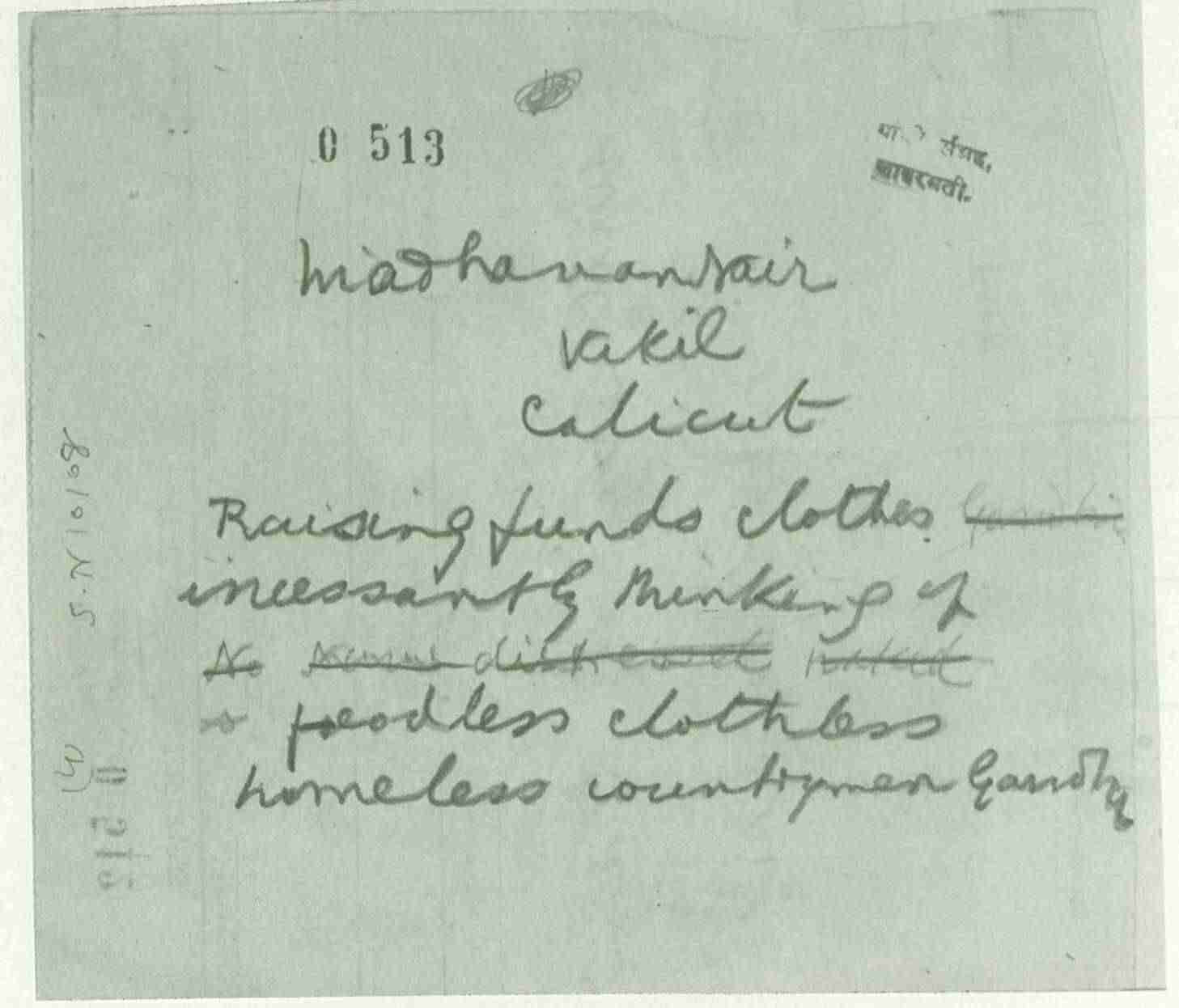
Met Mahatma Gandhi at Juhu and presented a detailed memorandum on caste discrimination in Kerala, helping secure Gandhi's support for the movement. Gandhiji accepted the memorandum and invitation to visit Kerala and came to Kerala in 1925.
Led rehabilitation work across flood-affected regions of Kerala and appealed to Gandhi for national support.


Elected Director of the Kerala Untouchability Committee.
Inaugurated the Vaikom Satyagraha.
Met Mahatma Gandhi at Juhu and presented a detailed memorandum on caste discrimination in Kerala, helping secure Gandhi's support for the movement. Gandhiji accepted the memorandum and invitation to visit Kerala and came to Kerala in 1925.
Led rehabilitation work across flood-affected regions of Kerala and appealed to Gandhi for national support.

1925
Elected the first President of the Kerala Pradesh Congress Committee, with K. Kelappan serving as Secretary. (refer: Sasi Tharoor's article in mathrubhumi)
Elected the first President of the Kerala Pradesh Congress Committee, with K. Kelappan serving as Secretary. (refer: Sasi Tharoor's article in mathrubhumi)
1926–1929
Elected unanimously to the Madras Legislative Assembly.
Declined a ministerial position to continue serving the Congress movement.
Campaigned tirelessly for tenant rights, contributing significantly to the passage of landmark landlord-tenant reforms.

In 1928, when Mathrubhumi faced severe financial distress, he mortgaged his personal belongings including his wife's jewelry to save the newspaper.

Elected unanimously to the Madras Legislative Assembly.
Declined a ministerial position to continue serving the Congress movement.
Campaigned tirelessly for tenant rights, contributing significantly to the passage of landmark landlord-tenant reforms.

In 1928, when Mathrubhumi faced severe financial distress, he mortgaged his personal belongings including his wife's jewelry to save the newspaper.

1930
Chosen to lead the Salt Satyagraha in Kerala after K. Kelappan's arrest.
Established a women's wing, encouraging women to participate actively in the freedom struggle. Appointed A. V. Kuttimalu Amma as the leader of the women's wing.
Organized campaigns promoting khadi, the boycott of foreign goods, prohibition, and civil disobedience.
Arrested and jailed once again for his participation in the movement.
Later directed the Guruvayur Temple Referendum, which played a significant role in opening the temple to lower-caste Hindus. (from The Collected Works of Mahatma Gandhi)

Chosen to lead the Salt Satyagraha in Kerala after K. Kelappan's arrest.
Established a women's wing, encouraging women to participate actively in the freedom struggle. Appointed A. V. Kuttimalu Amma as the leader of the women's wing.
Organized campaigns promoting khadi, the boycott of foreign goods, prohibition, and civil disobedience.
Arrested and jailed once again for his participation in the movement.
Later directed the Guruvayur Temple Referendum, which played a significant role in opening the temple to lower-caste Hindus. (from The Collected Works of Mahatma Gandhi)

Other Lasting Contributions
Beyond politics, K. Madhavan Nair made significant contributions to literature, journalism, and public life.
Authored Malabar Kalapam, the only eyewitness account of the 1921 Malabar Rebellion.
Wrote extensively in newspapers and journals.
Served as Mahatma Gandhi's Malayalam interpreter during Gandhi's visits to Kerala.
Received Gandhi's permission to translate The Story of My Experiments with Truth into Malayalam, which Mathrubhumi published in 1928.
Served as President of the Kozhikode Bar Association from 1931 to 1933.
A Legacy That Deserves Recognition
K. Madhavan Nair passed away in 1933 from leukemia at the age of just 51.
Although many of the institutions and reforms he helped build continue to shape Kerala today and Gandhiji came to Kerala honor him in January 1934, his contributions have received far less recognition than they deserve. His role in the freedom movement, the early history of the Kerala Pradesh Congress Committee, Mathrubhumi, social reform, and the struggle for equality is an important part of Kerala's history.
Remembering pioneers like K. Madhavan Nair is not merely about honoring one individual, it is about preserving the fuller story of Kerala's social reform movements and India's freedom struggle for future generations.
Researched and compiled by Padmini Pooleri, granddaughter of K. Madhavan Nair, based on archival material from the Sabarmati Archives, [SCRIBD], Shodhganga, Mathrubhumi publications, his biography, and other historical sources.
Gandhiji's speech when he honored K Madhavan Nair by unveiling his picture in the Kozhikode town hall on January 13 1921


Comments
Post a Comment